
Gratis gids 10 verborgen natuurplekken in Europa
Gratis gids 10 verborgen natuurplekken in Europa. Meld je aan voor onze nieuwsbrief en ontvang inspirerende reistips en routes voor je volgende groene reis.

Everyone knows the famous Palio of Siena, which is held twice a year. It’s the well-known horse race across the Piazza del Campo, the oval-shaped square in the city. But did you know that in Asti, in Piedmont is celebrated, and that it’s still going strong, is something not many tourists know.
I attended this spectacle, which is so much more than just a horse race. It might be a bit different from what you’re used to, but this unique folklore event is definitely worth checking out if you’re in Monferrato in the Piedmont region in September (which, by the way, is a great idea anyway).
Read about this exciting event that lasts an entire weekend and find out how you can attend it yourself.


This has been an annual tradition since 1275, with only brief interruptions over the past centuries. In 1275, the first race was held near the walls of Alba, purely as a show of power. For eight centuries, the tradition has evolved and adapted to the changes and events in the city and its surroundings. But the charm and tremendous dedication of the residents have remained.
The “palio” literally means the city’s banner. The race in Asti revolves around winning the banner. Twenty-one districts, villages, and municipalities compete for the banner. The winning district is allowed to carry the banner. The banner is designed annually by a contemporary artist. The colorful 2024 banner was created by Stefano Bressani.

In early May, the “Festa del Santo Patrono San Secondo” takes place. That same month marks the official kickoff for the Palio in September. The artist who will create “the banner” is selected—each year, a master of contemporary art. May also features flag-waving competitions, and the mayor officially announces the Palio for September. But the neighborhoods have been busy preparing all year long, from making costumes to practicing flag-waving. You can feel in everything that this contributes to the social cohesion of the neighborhoods. It’s a massive commitment for people of all ages.

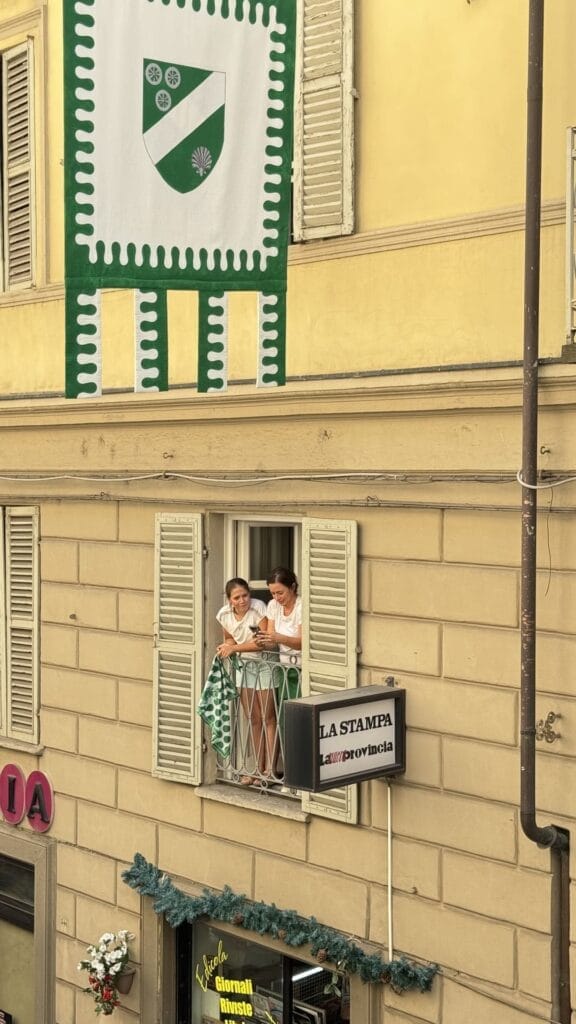

On the Friday and Saturday before the race in September, each district holds its own pre-race dinner for good luck. I had the privilege of joining the dinner in the village of Borgo Tanaro, a suburb of Asti, bordering the Tanaro River. It was quite an experience and a logistical feat—an outdoor dinner for 500 people. Fresh pasta was cooked in an adjacent old warehouse, and at long tables, young and old alike shared a deep love for the village and the palio. Songs were sung all evening, getting louder and louder. Everyone, including me, was wrapped in the blue-and-white scarf of Borgo Tanaro.
As it happened, this was the village where the mayor of Asti lives, so he was there, as was the jockey (il fantino) who was scheduled to ride in the race on Sunday. I was allowed to take a quick look at the horse in the stable. I had to be very quiet because he needed to rest properly.

On Sunday morning, the day of the race, the horses and riders are blessed by the parish priest. Here, too, there is silence as the horse enters. At 11 a.m., there is a performance by the flag bearers in Piazza San Secondo.
Fortunately, there is a growing focus on the health of the horses. A technical and veterinary committee determines whether a horse is healthy enough to participate. Incidentally, the jockeys themselves are not from the village in question, but are hired professional riders.


On Sunday afternoon, there is a procession featuring more than 1,200 participants in medieval costumes. At 2:00 p.m., the participants set off from Piazza Cattedrale and follow a route through the entire city center.
Magnificent, heavy fabrics and colorful velvet costumes showcase the immense effort put in by all the districts over the past year. It’s sweltering, and the costumes must be incredibly heavy. Every year, the village or district creates new costumes. It’s a magnificent sight and draws huge crowds of (local) onlookers.
The horse race itself is the highlight of the Palio, but lasts no more than a few minutes in total. The triangular Piazza Alfieri is transformed into an arena with surrounding grandstands and sand on the racecourse. The course is 450 meters long in total. There are 3 races, each consisting of 3 laps, and 1 final.
The jockeys ride the horses bareback. If a jockey falls off and the horse keeps running, you might still win the race: after all, it’s the horse that wins the prize, not the jockey.

A thick rope at the starting line is meant to keep the horses in check before the starting signal. The crowd cheers and the tension rises with yet another false start, because the horses are difficult to keep in position. The heat is intense, and there are short breaks between races to cool off—for the crowd as well.
After the three races, there’s a colorful display by the flag-wavers, followed by a “band break” and the final race with nine horses. The grand prize is, of course, the banner; second prize is a bag of coins. Our neighborhood, Borgo Tanaro, makes it to the final and finishes fourth. The prize: a live rooster…
Since 2018, the Palio has been held on the first Sunday in September. This means there are already a few days of events leading up to it, such as dinners in the neighborhoods.
You can order your tickets from the City of Asti. You can also order tickets for the dinners held before the Palio. If you’re unable to get tickets in advance, you can always go to Piazza Alfieri on the day of the event to purchase them. By the way, the procession is free to watch and is actually more spectacular than the horse race itself.
September is a great month to visit Monferrato in Piedmont. Asti has plenty of events planned for this month.

With a passion for travel and photography and over 30 years of experience in the travel industry, I love to share my special nature travel tips. Travel is wonderful and important, you meet new people and cultures and it opens your view of the world.
Hiking across smoking volcanoes: an organized hiking tour of the Aeolian Islands On Vulcano, you know you’ve arrived before you even set foot on shore. The sulfur already hangs over the harbor. A smell that hovers somewhere between a match and a boiled egg—and one you...
Sleeping in nature in Sardinia: handpicked accommodations, booked directly with the owner A unique place to stay in Sardinia. No nameplate on the door, no reception desk. Instead, an owner who pours you a glass of local wine upon arrival and tells you which trail is...
Get inspired
Are you looking for the most beautiful hiking and biking routes? Or do you want information about traveling by train or advice for the most beautiful road trips through nature. Get inspired for your next trip in green; ideas for planning your own trip or opting for an organized trip.