
Gratis gids 10 verborgen natuurplekken in Europa
Gratis gids 10 verborgen natuurplekken in Europa. Meld je aan voor onze nieuwsbrief en ontvang inspirerende reistips en routes voor je volgende groene reis.

The ancient pilgrimage route, the Via Francigena—a total of 2,496 km—runs from Canterbury to Rome. This route offers you a unique opportunity to discover the hidden gems of Piedmont.
This is where two beautiful branches of the Via Francigena converge, each with its own charm and history. The western route of this camino comes from France through the Val di Susa, a valley rich in cultural heritage, culminating in the impressive Sacra di San Michele.


The northern route begins at the St. Bernard Pass and runs through the Aosta Valley to Piedmont, passing through the charming town of Ivrea and the serene Lake Viverone.
Both routes meet at Vercelli and offer a unique blend of nature, history, and culture.
From Turin, we explored the northern Italian sections of both routes, focusing on accessibility for people with disabilities, thanks to the “Via Francigena for All” project. Read our tips for these beautiful hiking trails.
The trip takes us through picturesque villages, past serene lakes, and past impressive abbeys. It also offered us a few extra adventures in the bustling city of Turin.


Although these routes already existed in Roman times, the area remained off the radar for tourists for a long time. The fact that the Via Francigena is so old is evidenced by diary excerpts from Archbishop Sigeric of Canterbury, who traveled this route as early as the year 990 to visit the Pope in Rome.
You’ll walk past many vineyards, the most beautiful lakes, impressive monasteries, and a vast array of chapels, churches, and abbeys. Several decades ago, the Via Francigena was revitalized by England, France, Switzerland, and Italy, which equipped the trail with clear markings and covered rest areas. There are also sections suitable for people with disabilities, such as extra-wide paths and information signs with Braille.
Pilgrimage routes have their origins in the Roman Catholic faith. You walk toward the Pope to do penance. Nowadays, people walk these routes for all sorts of reasons—for example, for cultural, historical, spiritual, or athletic reasons. As a result, you’ll see many different types of hikers on these kinds of pilgrimage routes.


About 60 km north of Turin lies Ivrea, a city listed as a UNESCO World Heritage Site. This is not so much because of the historic monuments in the city center, but because of the mark Olivetti left on it.
The company—known for its famous typewriters—grew from 1908 through the 1980s to become a legendary enterprise. Olivetti took good care of its staff and, in addition to housing, had many other buildings constructed for its employees, including stores, movie theaters, and other amenities.
During the company’s heyday—in the 1950s—the city grew rapidly, resulting in a surprising combination of Brutalist and Modernist architecture right next to old classical buildings.
Fortunately, the Olivetti industrial complex has been preserved and has been open to visitors as a sort of open-air museum since 2001. It’s a very interesting place to explore, especially for architecture enthusiasts.
Ivrea lies on the wide Dora Baltea River, which, thanks to the natural rapids in its riverbed, is a popular spot for kayaking. We enjoyed a guided walking tour of Ivrea. With its deep roots in Piedmont’s industrial and medieval history, there is plenty to see. Guides can tell you all about the Olivetti Group, the castle, the abbey, and Ivrea’s famous carnival, featuring the traditional orange-throwing ritual.
For a simple lunch, head to the socially conscious, cooperative Lo Zac, located in a former shopping center that has been given a new lease on life, right next to the Ivrea train station. They also serve great vegetarian and vegan options. To try the legendary chocolate mousse cake “Torta 900,” head to Pasticceria Balla.


A pleasant hike is the section of the Via Francigena from Ivrea to Viverone. This 20-kilometer trail takes you through rolling hills and small villages such as Cascinette d’Ivrea, Burolo, and the beautiful village of Bollengo.
Here we made a brief stop to see some local sights and enjoyed a wine tasting at the Cantina della Serra wine cooperative in Piverone, followed by a delicious lunch at La Kascina – Pizzeria al Tegamino in Piverone.
In addition to growing the Olivetti family business, Adriano Olivetti also focused on local agriculture to preserve the landscape. In 1953, he helped found Cantina della Serra, a cooperative of winegrowers in an area dominated by industry. Today, Cantina della Serra has approximately 230 members who produce 8,000 hectoliters of wine, 70% of which is DOCG and DOC.
The vineyards cover 150 hectares, are mainly laid out in terraces to prevent erosion, and benefit from ideal conditions for growing high-quality grapes. You can visit the winery by appointment for a wine tasting.
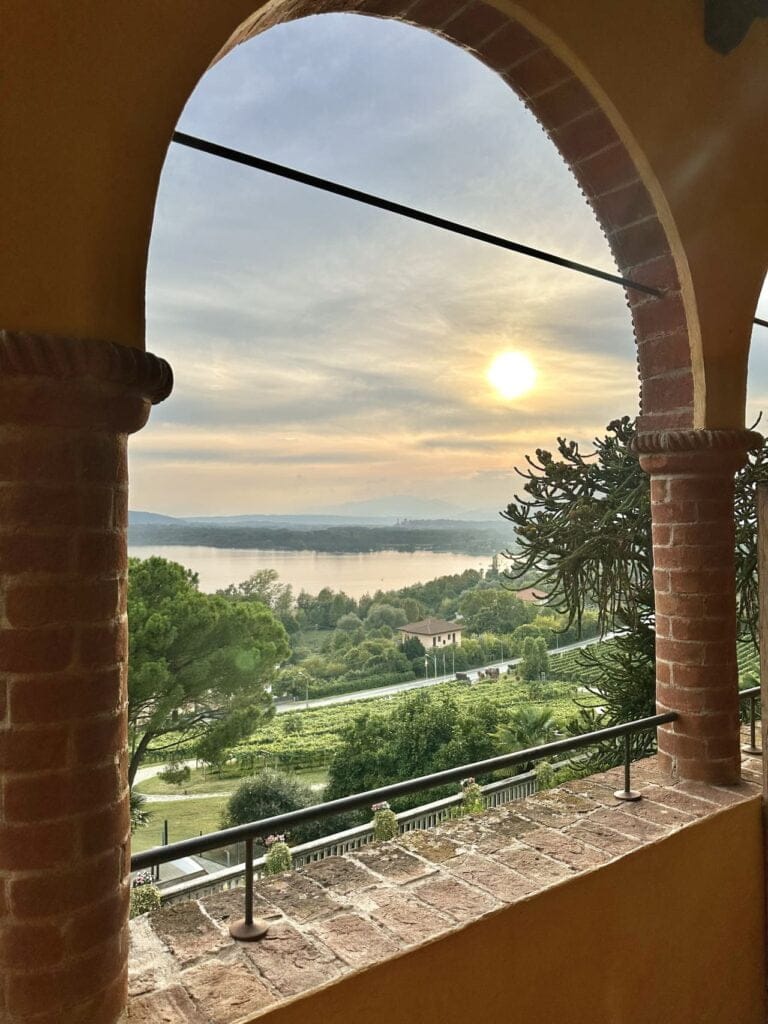
In the afternoon, we’ll continue on toward the serene Lago di Viverone. The lake offers beautiful views and is a peaceful place to relax after the long hike. You’ll find a number of old-fashioned eateries and bars there.
A little further up the hill lies the enchanting Hotel Cella Grande, which overlooks the lake. It features a winery and an exceptional restaurant (also open to non-hotel guests). The grapevines extend all the way to the impressive garden with its centuries-old trees. Don’t forget to ask for a room with a view of the lake!
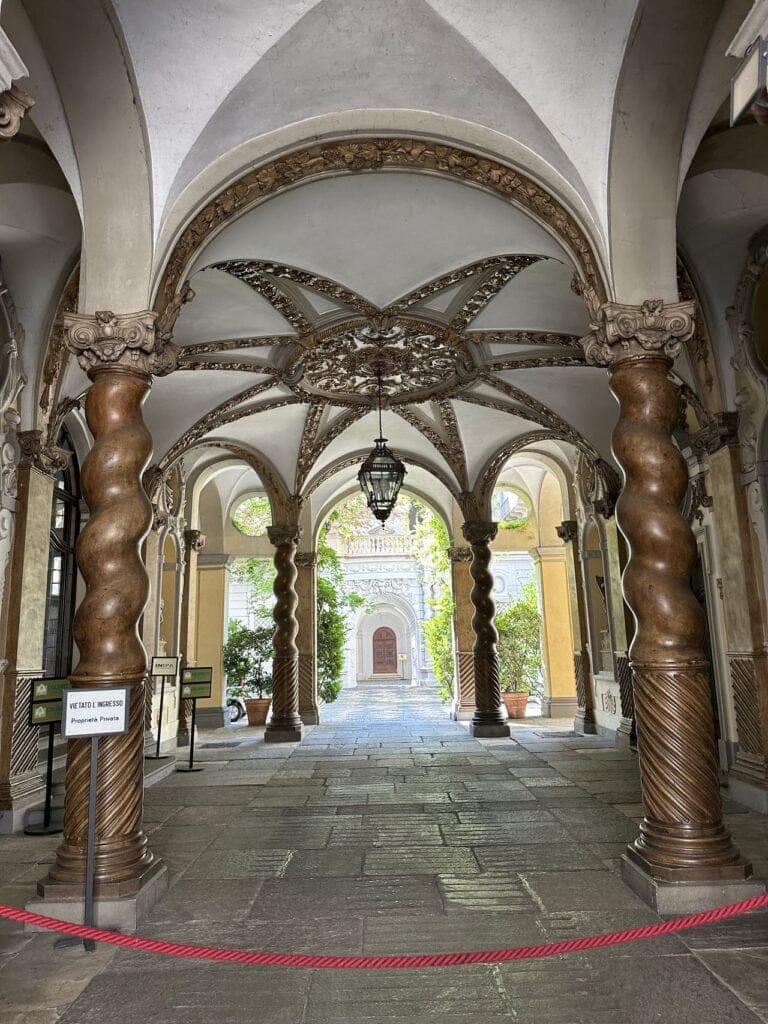
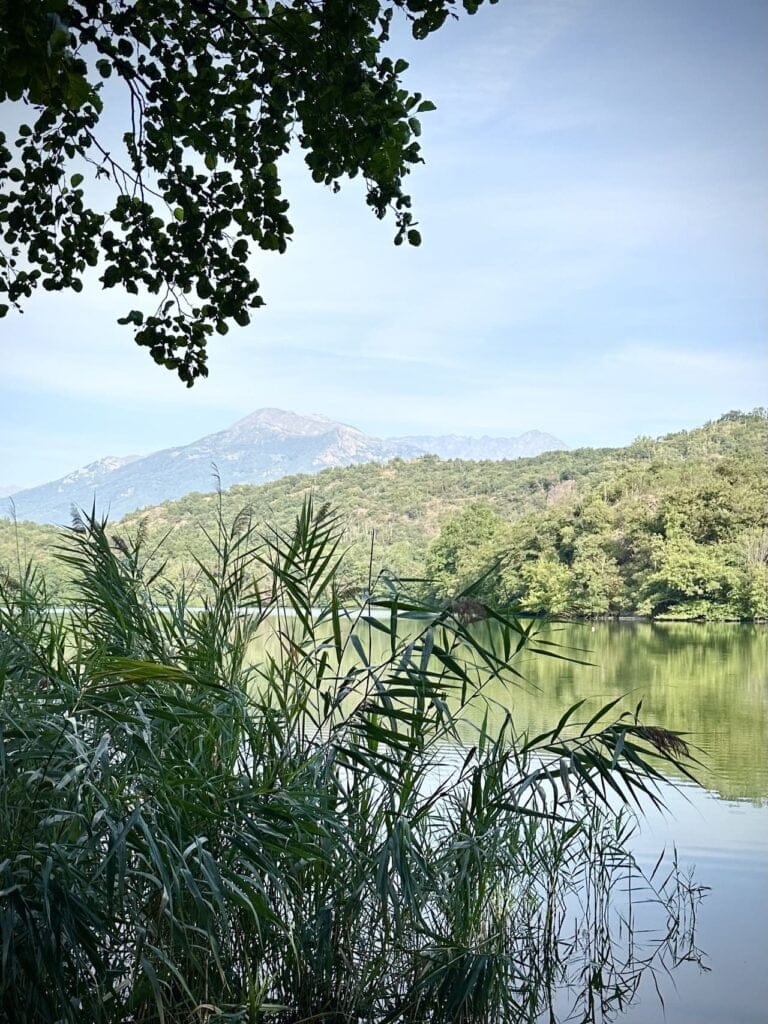
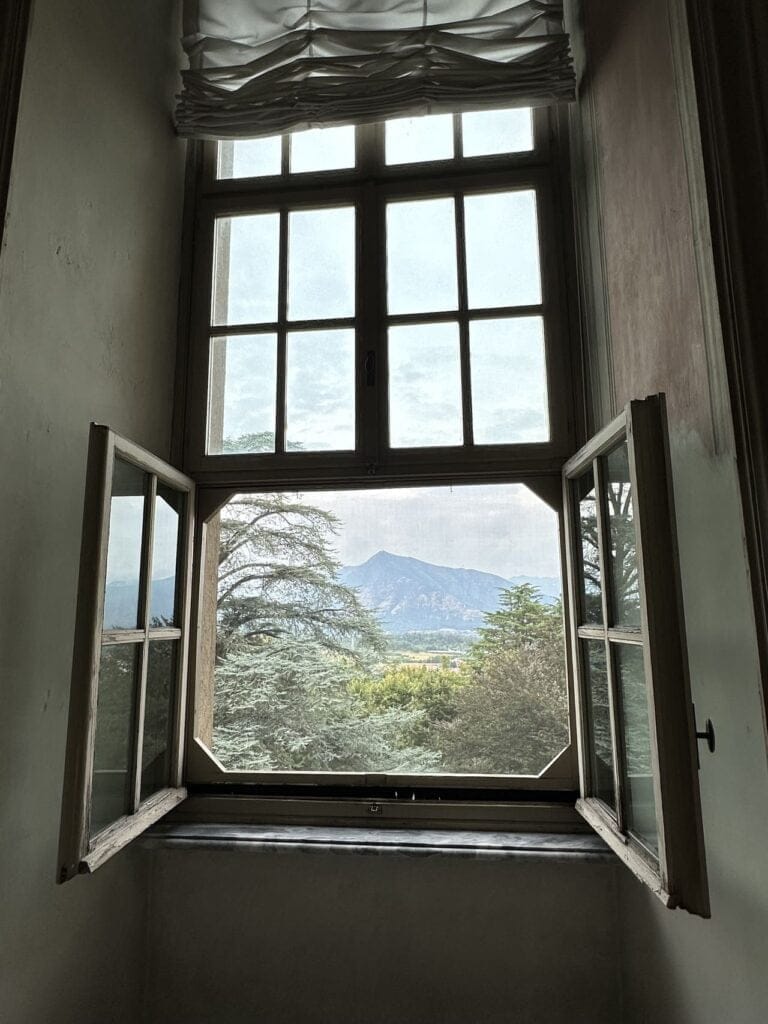
We head down to the other branch of the Via Francigena in the Susa Valley, where you’ll find the ancient Roman road to France. Thanks to its strategic location, it’s an area steeped in history.
A visit to the Benedictine Abbey of Novalesa, one of the oldest abbeys in the Alps (altitude 826 m), is a truly inspiring and peaceful experience. Set against the beautiful backdrop of the foothills of the Alps, this complex features several buildings, small churches, chapels, and a small museum.
Part of the monastery is still inhabited by monks. In the small chapel of St. Eldrad and St. Nicholas, you’ll find exceptional Byzantine frescoes from 1240 that are very well preserved. Even for non-religious visitors, the serene tranquility and beautiful location of the abbey, nestled in the Alps, make it well worth a visit.
Tips: Across from the abbey in San Pietro, you’ll find a cozy inn called Azienda Agricola Corbusier. Another option for lunch is the El Dorado Restaurant—a down-to-earth spot where Italian families gather for Sunday lunch.
In the town of Susa, we explored the famous Roman ruins and the medieval center. We began our tour at the Porta Savoia, one of the main gates to the city of Susa and a fine example of Roman military architecture. We also visited the Arco di Augusto, the Arch of Friendship, and saw the inhabited church and the amphitheater. The medieval fortress of Susa offers a magnificent view of the city and the valley. The Cattedrale di San Giusto is also worth a visit, with its blend of Romanesque and Gothic architecture and cornflower-blue cross vaults.


Here you’ll find a flat and leisurely stage of the Via Francigena, from Villar Focchiardo to Chiusa San Michele. Along the way, you’ll pass through charming villages such as Vaie and Sant’Antonino di Susa, and enjoy panoramic views of the surrounding mountains.
However, behind the little church in Chiusa San Michele, the flat path comes to an end and a hiking trail begins that takes you up the steep 600-meter climb to the Sacra di San Michele in about 1 hour.
The absolute highlight of this trip is a visit to the iconic Sacra di San Michele, an impressive abbey perched high above the Valle di Susa. The abbey, which dates back to the 10th century, inspired Umberto Eco to write his famous novel *The Name of the Rose*.
The height made us dizzy, and with clammy hands we climbed the stairs of death. To avoid crowds, it’s best to visit this special place in the late afternoon—just before the ticket office closes—after which you’ll have another hour to explore this mystical complex.


Tip: Spend the night at the serene Certosa 1515, a former monastery in Avigliana. Here, you can still really feel the simplicity of monastic life. For the past 100 years, this former monastery was home to nuns.
Restaurant tip: L’Om ‘d Fer in Sant’Ambrogio. A unique venue with a thousand-year history. For centuries, the dining room’s imposing stone walls served as the backdrop for lavish receptions and epic battles. This is beautifully combined with modern cuisine. There’s a panoramic terrace and a view of the Sacra di San Michele, which towers high above the restaurant.
Via Francigena for All: accessible to everyone thanks to an initiative by the European Association of Pilgrimage Routes. For example, the information provided along the route includes Braille text and illustrations of churches and buildings featuring reliefs. Bicycle paths have also been constructed so that parts of the route can be traveled by bike.
We wrapped up our trip in bustling Turin. A city that only recently, after the 2006 Winter Olympics, began to attract tourists. Turin, which isn’t all that large, is well worth a visit, featuring, among other attractions, the Egyptian Museum, which, following a renovation, is now considered one of the best museums in the world.


Another highlight of this region is the Museo d’Arte Contemporanea del Castello di Rivoli. We rented a bike in Turin and cycled 20 kilometers to one of Piedmont’s most remarkable cultural attractions. The flat bike ride takes you past dull, sprawling suburbs and industrial parks, but the destination is truly phenomenal.


Rivoli Castle, a UNESCO World Heritage Site, was once the palace of the House of Savoy, one of Europe’s oldest noble families. Today, it houses one of Italy’s most important collections of contemporary art.
You can admire works by internationally renowned artists as you wander through the castle’s majestic halls. The combination of modern art and the historic setting makes this museum a truly special experience.
The last day of the trip was all about mystery and adventure with the underground tour organized by Somewhere Tours in Turin. This tour reveals ancient catacombs, secret hideouts, and stories about alchemists and occult practices connected to the city.


We got a sneak peek at the Museo Pietro Micca. When you walk into this small but charmingly old-fashioned museum, you’d never guess what’s in store underground!
The museum is dedicated to the siege of Turin in 1706, and in particular to the heroic act of Private Pietro Micca, a local hero who sacrificed his life to protect the city from French troops.
What makes the museum truly unique is that you have the opportunity to explore the underground tunnels from the siege. These tunnels were used to defend the city, and a guided tour takes you on a journey through the exciting history of this conflict. Highly recommended for kids and also perfect for hot Italian summer days—the tunnels stay wonderfully cool!
Don’t forget to try a Bicerin at one of Turin’s beautiful historic coffeehouses. It’s a hot drink made with coffee, chocolate, milk, and cream that’s served in many cafés. For example: Caffè Fiorio or Caffè Al Bicerin. This drink, too, is a legacy of the House of Savoy. You’ll also find countless other sweet treats associated with the Piedmont region. Take the Gianduiotto, for example—a chocolate treat with roasted hazelnut pieces, wrapped in a beautiful gold wrapper. In addition to Stratta, you can find them at Baratti & Milano, Leon, and Peyrano.


Mieke Tacken
I am an interior designer, photographer, and an avid nature hiker. I’ve lost my heart to the simplicity and beauty of hiking vacations. I also appreciate the unique experience of a stay that tells a story about local history or culture. Here, I share my stories and tips—whenever possible, with a light footprint and always with a heart full of wonder.
Hiking to Trondheim along ancient pilgrimage trails What’s it like to hike for days along ancient pilgrimage trails to Trondheim? During a trip through Sweden and Norway, I hiked several sections of the St. Olavsleden. From the open border mountains near Skalstugan to...
Hiking the St. Olav Trail: Route, Stages, and Tips A thousand years ago, Olav Haraldsson traveled this road northward in search of his crown. He met his death at Stiklestad and was canonized three years later. Since then, pilgrims have followed the same route: from...
Just twenty minutes past the coast lies a completely different Málaga Twenty minutes by car from Málaga Airport, the highway turns into a winding road leading into the mountains. The coast disappears behind you, and ahead lie olive and almond trees, karst rocks, and...
Get inspired
Are you looking for the most beautiful hiking and biking routes? Or do you want information about traveling by train or advice for the most beautiful road trips through nature. Get inspired for your next trip in green; ideas for planning your own trip or opting for an organized trip.