
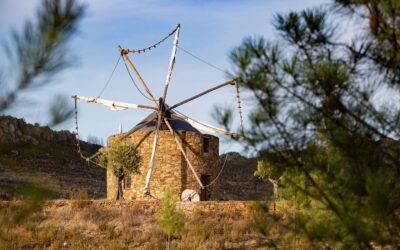
Moinho da Fadagosa
- Sleeping in a Windmill
- For 2 people in Maçao, Central Portugal
- Swimming in the river
- Wonderfully peaceful and doing nothing
- Wine tasting, pizza, or hikes available upon request

Combine your city trip to Porto and Lisbon with a stunning route through nature. This trip (which we took in February) is a week filled with sunshine, picturesque cities, and unexpected discoveries in nature, as you follow the breathtaking Douro River from Porto to Lisbon.
It’s a journey through the history and culture of unique Portugal. Read about the road trip between the two cities. Of course, you can also do the route in the opposite direction.


This city is fascinating all year round. With a handy map, you can explore the city. Admire the beautiful train station with its azulejos that tell the story of its history; enjoy the stately homes and green parks. Discover the Porto of Harry Potter, where J.K. Rowling found her inspiration. You’ll be amazed by the stunning Livraria Lello bookstore.
Tips for Porto:


Your next day began with a delicious breakfast, followed by a leisurely ride on the old wooden tram to the beach. On the way back, you’ll stroll along the Douro River, past wineries and the impressive Church of St. Francis with its catacombs. Porto proves that it’s worth every step. In Porto, you can get around on foot, by bike, or by tram. A car is absolutely unnecessary here.
Coimbra, a somewhat forgotten city nestled between the famous cities of Porto and Lisbon, but this former capital of the Kingdom of Portugal is well worth a visit. The city is divided in two by the Mondego River. It was the capital of the Kingdom of Portugal during the Middle Ages and has a long and significant history.
In 1290, King Dinis founded Portugal’s first university in Coimbra. The university is also one of the oldest in the world. The Coimbra student organization played a central role in the country’s subsequent history as a defender of the values of freedom and democracy, served as a bastion of resistance, and stood up against the Estado Novo dictatorship. Initially confined to the Royal Palace, the university spread throughout Coimbra, transforming it into a university town and earning it the title “Coimbra, City of Knowledge.”


It was also within the university that “Fado de Coimbra” was born, a musical expression unique in the world. The poems and artists evoke sweet serenades about love and longing for a woman, for the city, and for the Academy. The songs are accompanied by special round-bodied acoustic guitars.
Today, Coimbra is a UNESCO World Heritage Site thanks to its many historic buildings and the city’s significance in the history of Portugal.
Coimbra was also the setting for one of the most beautiful and tragic love stories that still lives on in the Portuguese imagination today: the forbidden love between D. Pedro of Portugal and D. Inês de Castro. It was in Coimbra that sparks flew between the heir to the Portuguese throne and the Galician noblewoman. Their tombs can still be visited in the magnificent monastery of Alcobaça (an hour’s drive south of Coimbra).
The Joanina Library was named one of the most beautiful libraries in the world by The Telegraph. The library was built in the 17th century using gold reserves discovered in Brazil. It is located in the Paço das Escolas at the University of Coimbra.
The site where Portugal’s second king, D. Sancho I, was crowned serves as the stage for the monumental serenade that marks the beginning of “Queima das Fitas” (literally, “burning of the banners”). On the first Friday in May, students celebrate the end of the academic year by burning the banners of the various faculties and performing a serenade at midnight on the steps of the impressive cathedral. The Queima lasts eight days (one day for each faculty) and has now evolved into a festival featuring a parade and floats. It is one of the largest student events in Europe.
Continuing along the Douro Route, you’ll arrive in Alvados, at the Cooking & Nature hotel. At “the Nest,” you’ll experience complete tranquility surrounded by nature. There’s one local restaurant, but you can also dine at Cooking & Nature. The next day, take an e-bike tour along the breathtaking route lined with orange and olive trees—it’s unforgettable.


A new highlight awaits you in Nazaré: the world’s highest waves crash along the coast. Surfers brave these impressive waves—a thrilling spectacle. A little further on, you can try your hand at calmer waters. From here, continue on to Lisbon!


Of course, the best way to explore Lisbon is by taking tram 28. Stroll through the narrow alleys of Alfama, which were spared by the 1755 earthquake. You’ll enjoy a stunning view from one of the city’s rooftop bars, such as the one at Hotel Mondial. You definitely don’t need a car in Lisbon. Everything is easily accessible on foot or by tram.


Of course, try a Fado restaurant. A chance encounter with an elderly man led us to Trovas Antigas, a “non-touristy” Fado restaurant in the bustling Bairro Alto neighborhood. An evening filled with enchanting music and delicious food.

With a passion for travel and photography and over 30 years of experience in the travel industry, I love to share my special nature travel tips. Travel is wonderful and important, you meet new people and cultures and it opens your view of the world.
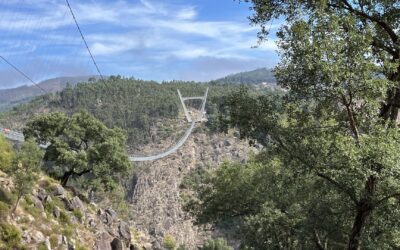
Hiking in Arouca: The Most Spectacular Hiking Trails in Portugal's Lush North 516 meters long, 175 meters above a raging river, and no turning back halfway across. That’s the Arouca 516 suspension bridge, the icon of the Arouca UNESCO Global Geopark. This geopark is...
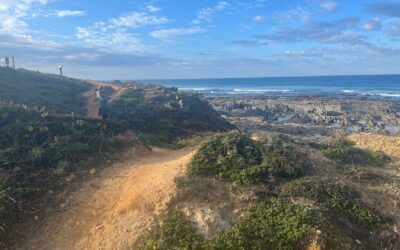
8-day hiking trip Rota Vicentina: the Fishermans trail with local specialist Self-guided, fully taken care of by a local specialist: Fishermen's Trail from Cercal to Odeceixe On day five you board a boat to cross the mouth of the Mira River. No bridge, no timetabled...
Get inspired
Are you looking for the most beautiful hiking and biking routes? Or do you want information about traveling by train or advice for the most beautiful road trips through nature. Get inspired for your next trip in green; ideas for planning your own trip or opting for an organized trip.