Cycling the Merenroute: 227 kilometers through Switzerland at a leisurely pace
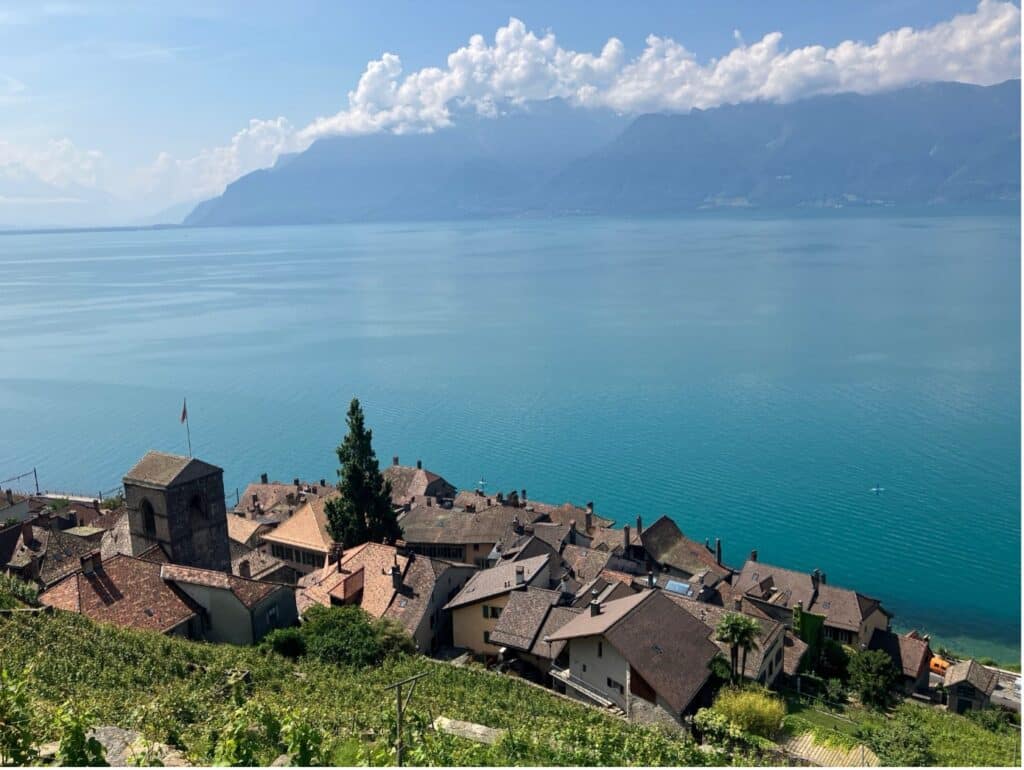
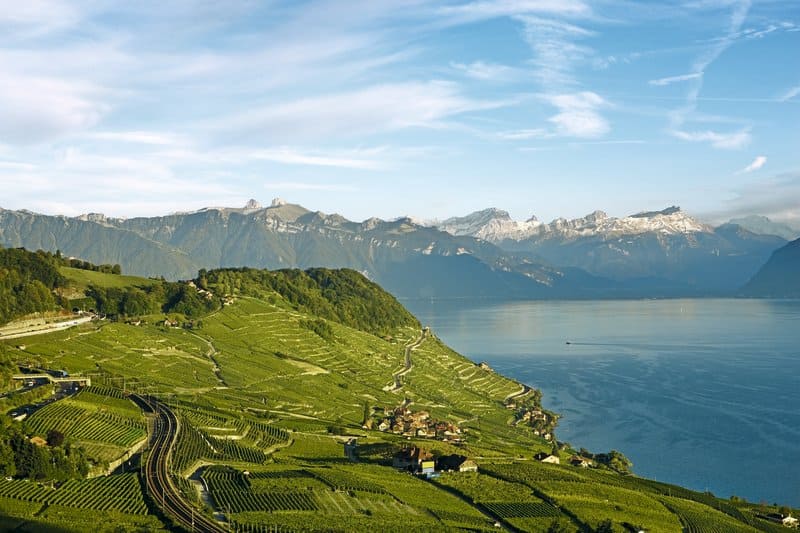
The first thing you hear isn’t traffic, but a cowbell. You’re standing in Vevey, on the shore of Lake Geneva; you’ve just dropped off your suitcase at the baggage counter, and for the next five days, all you’ll need is a daypack. Ahead of you lie 227 kilometers of Switzerland. Not the tour bus version, but the one you’ll experience from the saddle. Go directly to prices and request a quote.
The Lakes Route (Seen-Route, National Cycling Route No. 9) runs from Lake Geneva to Lake Lucerne, passing one lake after another along the way. No grueling mountain stages for seasoned cyclists, but a route that takes you past cheese-making villages, glacial valleys, and wooden chalets—with the occasional steep climb between two lakes. You book it directly with our local specialist, who arranges the accommodations, luggage transport, and navigation for you. All you have to do is ride.
The route: from Lake Geneva to Lake Lucerne
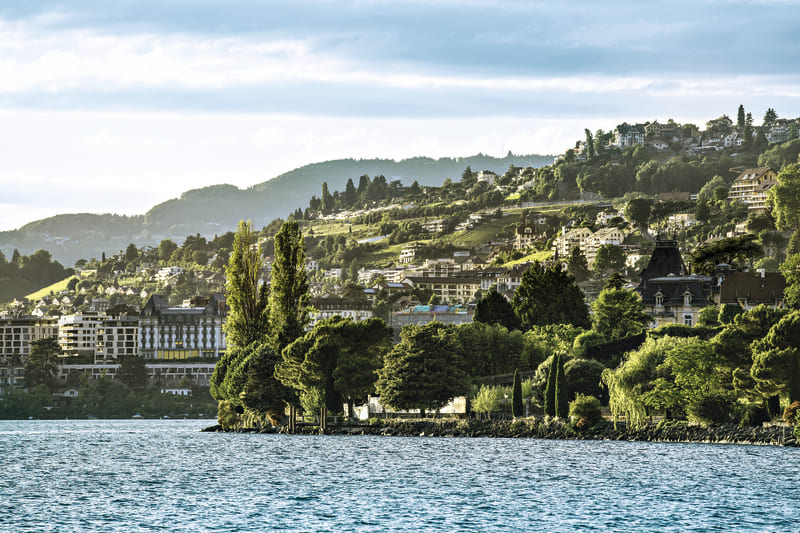
The Lakes Route connects the famous towns of Montreux, Gruyères, Gstaad, Interlaken, and Lucerne, but lets you experience them from the saddle. That changes everything. No buses rushing by, no hunting for parking: you simply cycle on as the landscape unfolds before you. And because you set your own pace, you stop where the tourist keeps riding. At that cheese factory along the road, that bench by the lake, the village you’d otherwise ride right past.
The tour consists of five stages, each with its own unique character. Together, they cover approximately 227 kilometers, spread over five days and four nights.
Day 1: From Vevey to the Gruyères region (approx. 40–50 km)
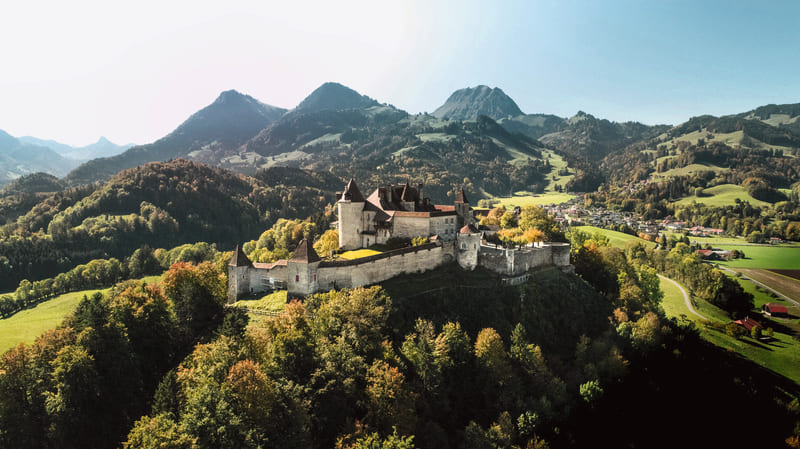
Drop off your luggage in Vevey, hop on your bike, and head south. You’ll ride along quiet roads to the heart of the Gruyère region. The land of the cheese of the same name, of rolling green hills, tinkling cowbells, and farms that have looked the same for centuries. A short, gentle first stage: a warm introduction to the Swiss rhythm.
Day 2: From Gruyères to the Gstaad region (approx. 46 km)
Today you’ll cycle through the Pays-d’Enhaut and the Saanenland: picture-perfect Switzerland at its best. Chalets with wood carvings, cheese dairies along the route, the first snow-capped peaks in the distance, and the centuries-old tradition of paper cutting. Gstaad is your final destination: notorious as a chic ski resort, but surprisingly laid-back outside of peak season.
Day 3: From Gstaad to Spiez (approx. 53 km)
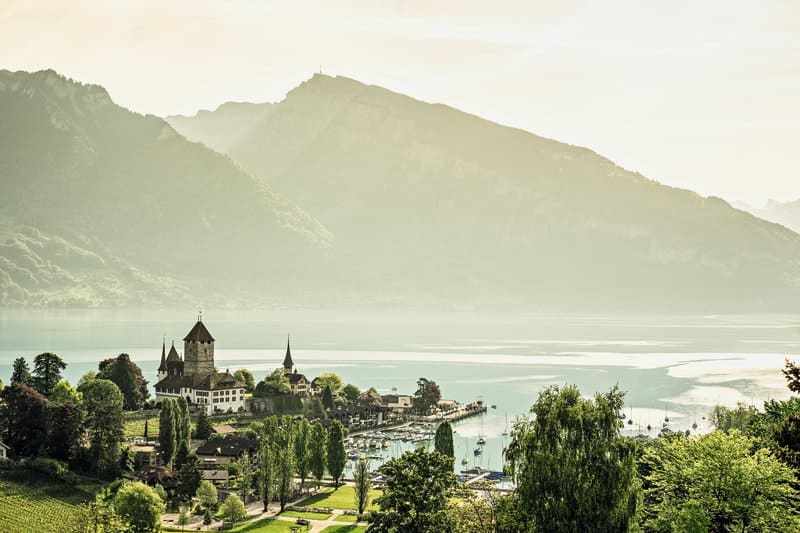
The Simmental Valley is one of the most beautiful sections of the route. The wooden houses here are works of art in their own right, each with carved facades and painted shutters. The Simme is a wild mountain river; as you cycle along the bank, canoes and rubber boats dance on the current. The route ends in Spiez, a water sports village on the azure-blue Lake Thun.
Day 4: From Spiez to Lake Sarner (approx. 60 km)
The longest and most varied day. In the morning, you’ll take the boat from Spiez to Interlaken; put your feet up and have your camera ready. Along the shore of Lake Brienz, the route climbs steeply in places to Meiringen, after which you take the train over the Brünig Pass. On the other side lies Obwalden: a small canton with a large valley, scattered hamlets, tranquil lakes, and long-standing traditions.
Day 5: From Lake Sarnen to Lucerne (approx. 33 km)
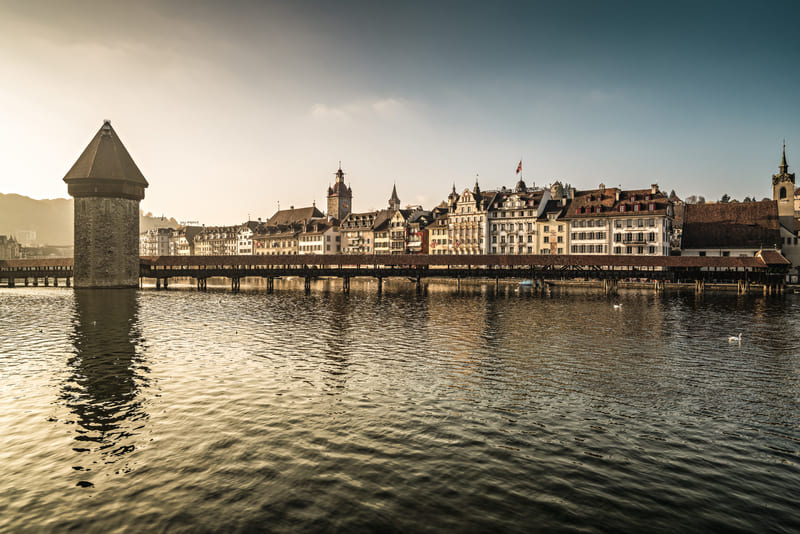
The final stretch. As soon as Lake Lucerne comes into view, Mount Pilatus towers above you. Bay after bay, you cycle toward Lucerne; the one city where every traveler eventually ends up, and for good reason. Here you return your bike, pick up your suitcase, and travel back at your own pace. Or you can just stick around for one more night.
When you’re on a bike, you actually get to see the parts of Switzerland that the tour bus just zooms past.
Why you should take this route by bike (and not by car)
You can rush through Switzerland by car in two days. But then you’ll miss exactly what it’s all about. On a bike, your attention shifts to the details: the clump of herbs along the road, the color of the meadows in late spring, the sound of a stream you would never have heard otherwise. You travel more slowly, and thus more deeply.
And since you’ll find the most peace and quiet outside of peak season—in May and June the meadows are in bloom, and in September and October the hillsides turn golden yellow—you’ll also be helping to spread tourism more evenly.
Everything is taken care of by the local specialist
The best part of this trip: you ride it yourself, but you don’t have to arrange anything on your own. You book direct with our Swiss specialist in self-guided cycling and hiking tours. They take care of:
Accommodations in carefully selected mid-range hotels, including breakfast
Daily luggage transport (one suitcase per person, max. 20 kg). You’ll be cycling with just a daypack
The boat trip from Spiez to Interlaken
Detailed directions plus a navigation app with GPS tracks, which can also be used offline
An annual subscription to SwitzerlandMobility-Plus
A service hotline for when you’re on the go
Self-guided means: no group, no guide rushing you along, no set schedule. You set off whenever you like and stop wherever you please. Ideal for couples, solo travelers, and small groups who prefer to go at their own pace.
Tip from Madelon: Can’t decide between a regular touring bike and an e-bike? The route is mostly flat along the lakes, but the sections connecting them can be challenging. If you mainly want to enjoy the scenery (and the cheese), go for the e-bike.
Take the train to the starting point (leave the car at home)
Both Vevey and Lucerne are easily accessible by train , even from the Netherlands. Not only does this save you the hassle of finding parking, but it also aligns with the way we prefer to travel: with as little impact as possible. The organization also gives you an SBB voucher worth CHF 10 per person, which you can use to get a discount on your train ticket within Switzerland. Just drop off your suitcase at the baggage counter at the station; it’ll be waiting for you at the end of the day.
Practical Information on the Switzerland Lakes Route
Route
Lake Route (Seen-Route No. 9), Vevey–Lucerne section
Distance
Approx. 227 km, divided into 5 stages
Duration
5 days / 4 nights
Level
Moderate. Runs right along the lakes, with some climbs in between (e-bikes are recommended for those who prefer a more leisurely pace)
Type
Self-guided (couples, individuals, small groups)
Season
Approx. late March–mid-October; best time to visit: May–June and September–October
Departure
Vevey (accessible by train)
Arrival
Lucerne (return by train)
Price
March 26–April 24 and September 26–October 18: CHF 999 per person; April 25–September 25: CHF 1,059, based on double occupancy. Additional nights can be booked upon request.
Surcharge for 1 person
CHF 219
Bike Rental
Optional: 27-speed touring bike (CHF 145) or e-bike (CHF 255)
What’s included
Breakfast, luggage transport, boat trip from Spiez to Interlaken, and navigation
Request a quote for the Switzerland Lakes Cycle Route
When you request a quote, we’ll forward it to our local partner, who will confirm it directly with you if approved. You’ll pay the same price as if you were booking directly. You’ll handle the rest of the booking and payment directly with the local provider (with whom we have a good working relationship and established agreements). We’re always available to answer any questions you may have.
"*" indicates required fields
Frequently Asked Questions About Cycling the Switzerland Lake Route
How challenging is the Lake Route from Vevey to Lucerne?
The route is considered moderate. The terrain is mostly flat along the lakes, but there are shorter and longer climbs between them. If you’d like to take it easy, choose an e-bike; athletic cyclists can ride the stages on a regular touring bike and shorten the route by taking public transportation.
How is luggage handled?
Our local partner provides daily luggage transport: one suitcase per person, up to 20 kg. You drop off your luggage in the morning, and it will be back at your hotel by evening. While on the road, you’ll cycle with just a daypack.
When is the best time to take this bike tour?
The trip is available from around late March through mid-October. The best times to visit are late spring (May–June), when the meadows are in bloom, and early fall (September–October), when the hillsides turn golden yellow. Plus, the route is quieter then than during the busy summer months.
Should I join a group or hire a guide?
No. This is a self-guided tour. You cycle at your own pace, set off whenever you like, and there is no guide or group accompanying you. Navigation is handled via an app with GPS tracks, and if you have any questions along the way, there is a service hotline available.
Is the route accessible by train?
Yes. Both Vevey and Lucerne are easily accessible by train, even from the Netherlands. So you don’t need to bring a car. And the organizers will give you an SBB voucher worth CHF 10 off your train ticket in Switzerland.
How much does the trip cost?
The base price starts at CHF 999 per person for 5 days / 4 nights, including accommodation with breakfast, daily luggage transport, the Spiez–Interlaken boat trip, and navigation. Bike rental is optional. The exact price depends on the departure date and availability.
With a passion for travel and photography and over 30 years of experience in the travel industry, I love to share my special nature travel tips. Travel is wonderful and important, you meet new people and cultures and it opens your view of the world.
8-day hiking trip Rota Vicentina: the Fishermans trail with local specialist Self-guided, fully taken care of by a local specialist: Fishermen's Trail from Cercal to Odeceixe On day five you board a boat to cross the mouth of the Mira River. No bridge, no timetabled...
Cycling or taking public transportation along the Romantic Road: a road trip through Bavaria without a car Cycling or taking public transportation along the Romantic Road sounds like a contradiction: after all, the word “Strasse” practically screams “car.” Yet this is...
Hiking across smoking volcanoes: an organized hiking tour of the Aeolian Islands On Vulcano, you know you’ve arrived before you even set foot on shore. The sulfur already hangs over the harbor. A smell that hovers somewhere between a match and a boiled egg—and one you...
Last September, we had a wonderful six-day hiking vacation from Bologna to Florence (Via Degli Dei). Not only was the weather perfect, but the organization also contributed to this wonderful experience. The hotels were good, and our luggage was always delivered to the hotel before we arrived. The private transfer was on time, and communication via WhatsApp during our hiking week went smoothly as well; responses were quick and clear. We can therefore definitely recommend this hiking vacation through Nature Travel Lab!
After reading the report on the “Alpenüberquerung,” we got really excited. The combination of hiking through beautiful nature and the luxury of luggage transport and a reserved hotel perfectly meets our desire to stay active but then be able to enjoy a well-deserved drink and a delicious meal. The hikes were manageable for us and very varied; some basic fitness is required, especially since we aren’t used to the elevation gain. The trip really gives you the feeling that you’re on a hiking expedition, especially since you hike on your own but meet the same fellow hikers in the afternoons and evenings at one of the mountain huts or at the hotel. Highly recommended for hikers who love unspoiled nature combined with the luxury of a hotel!
Peloponnese Hiking Tour
A really beautiful six-day hike from Bologna to Florence. Communication with NatureTravelLab and the local agent was excellent. The information packet was waiting for us at the hotel in Bologna, and the app with the route worked great. Luggage transport was well organized every day, and our bags were waiting for us each time we arrived at our new room! We covered more than 1,400 meters of elevation gain, but unfortunately didn’t always get the views we’d hoped for due to cloud cover and some drizzle. Most days had great hiking weather. It was wonderful to walk into Florence on foot and stay there an extra day.
We experienced the Walk of the Gods as a great adventure. Our start in Bologna didn’t go quite as planned because our app wasn’t working yet and we couldn’t find a single sign for Via degli Dei in the square. Fortunately, we were quickly able to join two young hikers from Florence who were also doing the hike. After a wonderful night’s stay at the beautiful Rio Verde agritourism farm, Day 2 went much better with the help of the hiking app. Along the way, we enjoyed stunning views, met some great fellow hikers, and sampled delicious local dishes. Unfortunately, the weather wasn’t always on our side, and we had a day of heavy rain, which made the trail very slippery and required us to be careful. It’s a real treat when, on the last day, you can already see Florence in the distance and walk into this beautiful city a few hours later. Thank you so much for your quick and friendly responses to all our questions.
We enjoyed the trip. We also made some changes to our itinerary, and the email correspondence went very smoothly. We started in Mantera; the next day, our first and only hike was a really beautiful one. The taxi picked us up right on time. Unfortunately, the second day’s route was almost the same when we cycled to Ostuni. The bikes were well-maintained, including panniers and helmets (these were simply included). You could even bring your own water bottle!!! We found the route very scenic and varied. There were charming little villages where we could stop for lunch or coffee. The app worked great. All the hotels ranged from good to excellent, though we didn’t think the hotel in Leuca was worthy of 4 stars. We followed your advice for the two nights we stayed there. We found Leuca a bit underwhelming for a two-day stay. We would have preferred to stay in Gallipoli or Lecce for two days. We took this trip in April and were very lucky with the weather. It’s still a quiet time of year, but we didn’t mind that. We definitely recommend it!!!
Thanks to a great tip from Nature Travel Lab, we had a wonderful week in Italy. Fattoria di Maiano, just outside Florence, was a beautiful and peaceful place. And the suggested road trips were a great guide for exploring the region. We’ll definitely check here for tips for our next vacation, too. Highly recommended!
We spent a divine week in Italy: we walked the Path of the Gods, from Bologna to Florence—about 135 km spread over 6 days of hiking. Challenging distances and climbs, amazing views, nature, and a warm welcome every time we arrived at the agriturismo or albergo/hotel. All of this was perfectly organized by the Italian company Slow Active Tours, entirely in line with Nature Travel Lab’s itinerary proposal: upon arrival in Bologna, an information packet was waiting for us, including a hiking map, a booklet, and passports for the stamps. And the hiking app was very practical while on the trail! Our luggage was transported every day and was always waiting for us when we arrived at the next location. Communication was smooth and clear. In short, highly recommended, well worth it, and well organized.
In September, I walked the Cammino Materano. Communicating with Madelon about the booking was a pleasure. To be honest, I was quite nervous because it was my first time doing a multi-day hike—alone and in a region I wasn’t familiar with—but I thoroughly enjoyed it. The hike to Matera was beautiful, and I was able to complete it without any trouble thanks to the clear on-site signage and the routing and advice provided by the GPS app. The rest of the organization was top-notch as well. My luggage always arrived on time at the right destination, and the hotels and B&Bs were of high quality. In addition, the organizers were easy to reach via WhatsApp if I had any questions. Highly recommended!
Slovenia was absolutely amazing. A beautiful country, friendly people, lovely hiking trails, and truly top-notch hotels. The staff at the local organization were also very easy to reach and helpful. The hiking was manageable. As Dutch people, we’re not used to high altitudes, of course, so it was pretty tough at times. But it was also a lot of fun.
We had a wonderful trip. Everything was well organized. Due to an unfortunate fall, I ended up traveling with my luggage for a day, but that was handled well, too. We really liked all the accommodations. Only the Hotel Hebe in St. Piero a Sieve was a little less impressive, but it was still okay.
Looks fantastic! I'm definitely going to book a trip with this company... they're committed to sustainability and personalized advice. Definitely worth it.
Madelon and her team are true experts. Thanks to their years of experience and passion for travel, they manage to surprise us time and time again.
Beautiful hikes, the most picturesque spots—it’s a real treat.
I highly recommend them!
Nature Travel Lab provided us with very helpful and honest assistance!
If you’re looking for travel itineraries, the most beautiful hikes, and destinations, you can find it all here. You’ll find endless inspiration for your next trip. Beautiful cities are interspersed with nature. You’ll find everything you need to know about practical matters. Plus, there are plenty of tips for sustainable travel. That way, you’ll get the most out of your trip.
45
Get inspired
Are you looking for the most beautiful hiking and biking routes? Or do you want information about traveling by train or advice for the most beautiful road trips through nature. Get inspired for your next trip in green; ideas for planning your own trip or opting for an organized trip.
To provide the best experiences, we use technologies like cookies to store and/or access device information. Consenting to these technologies will allow us to process data such as browsing behavior or unique IDs on this site.
Functional
Always active
The technical storage or access is strictly necessary for the legitimate purpose of enabling the use of a specific service explicitly requested by the subscriber or user, or for the sole purpose of carrying out the transmission of a communication over an electronic communications network.
Voorkeuren
De technische opslag of toegang is noodzakelijk voor het legitieme doel voorkeuren op te slaan die niet door de abonnee of gebruiker zijn aangevraagd.
Statistics
The technical storage or access that is used exclusively for statistical purposes.De technische opslag of toegang die uitsluitend wordt gebruikt voor anonieme statistische doeleinden. Zonder dagvaarding, vrijwillige naleving door je Internet Dienst Provider, of aanvullende gegevens van een derde partij, kan informatie die alleen voor dit doel wordt opgeslagen of opgehaald gewoonlijk niet worden gebruikt om je te identificeren.
Marketing
De technische opslag of toegang is nodig om gebruikersprofielen op te stellen voor het verzenden van reclame, of om de gebruiker op een site of over verschillende sites te volgen voor soortgelijke marketingdoeleinden.