
Gratis gids 10 verborgen natuurplekken in Europa
Gratis gids 10 verborgen natuurplekken in Europa. Meld je aan voor onze nieuwsbrief en ontvang inspirerende reistips en routes voor je volgende groene reis.

Bear watching in Slovenia might be closer than you think: in the forests near Postojna, just over an hour from Ljubljana. Nathalie joined us in the observation hut one evening.
Slovenia is often called the green heart of Europe. That’s not surprising when you consider that more than half of the country consists of dense, expansive forests. As a result, Slovenia provides the perfect habitat for brown bears and other mammals such as lynx and wolves. Especially for Nature Travel Lab, I went “bear hunting” with a guide in a regional nature park near Postojna, in western Slovenia.
Read more here about the most beautiful spots in Slovenia.
The tension is palpable in the van that’s taking us deep into the dense forests at an altitude of about 1,000 meters. Everyone is looking out the window with anticipation. My imagination quickly runs wild, because I see the head of a brown bear in almost every large tree stump.
As we drive, our guide, Grega, gives instructions in a stern tone about what lies ahead. His name is a typical Slovenian name and means “vigilant.” That’s quite fitting for a guide on wildlife trips. He tells us that we’ll be able to get out of the van shortly to stretch our legs and use the restroom, because once we arrive at the observation hut, we’ll have to sit still for about two hours. We’re not allowed to bring any food, just a bottle of water.
If we park a few minutes away from the observation hut, we’re not allowed to talk at all. During the fairly strenuous hike through the forest to the observation hut, your shoes mustn’t make a single sound. In the van, Grega had already told us that an estimated thirty bears live in these woods.
Across Slovenia, there are a total of between 950 and 1,000 bears. Other large mammals that call this area home include lynx and wolves. Grega has mentioned before that lynxes are extremely shy, so you’ll almost never be able to spot one. And wolves and bears aren’t exactly “friends,” so you usually won’t find them in the same area. Except on Grega’s arm, where a huge tattoo of a wolf takes pride of place.
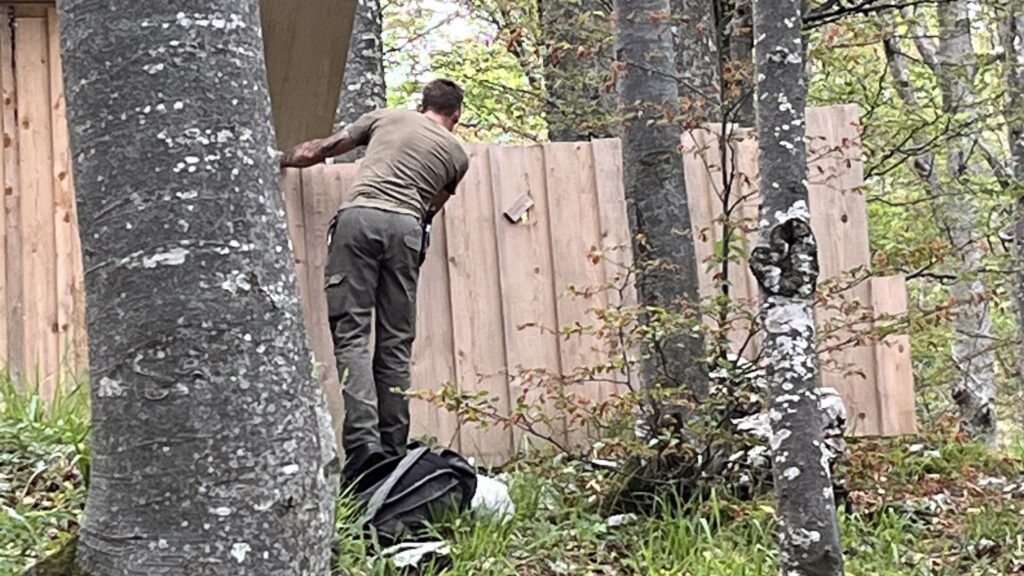
Very occasionally, there might already be a bear in the area, which is why he goes ahead while we stand in a line waiting. Suddenly, I notice a gun dangling from a holster on his hip. This makes me realize that we really are in the world of wild animals and that it’s not always without danger.
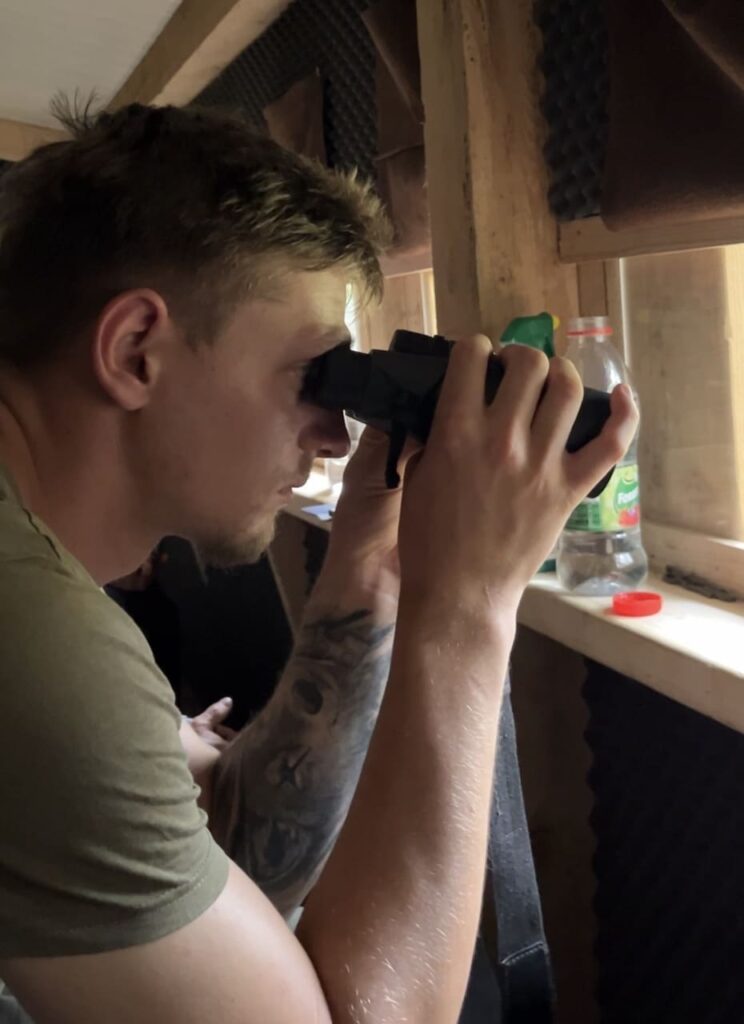
A moment later, Grega beckons us, and we sneak up the last bit of the way to the entrance of the wooden cabin. Inside, the room is lined with insulation material like the kind used in radio studios. It’s pitch black in there. All to ensure we don’t disturb the animals. There are two benches where the six of us sit down.
Black curtains hang in front of the small viewing windows; we secure them to two hooks above the window. And then the waiting begins. And we mustn’t make a sound. I can hear myself swallow—that’s how quiet it is in the room. Other than that, there’s no sound. It’s also extremely hot in the observation hut, but I don’t dare take off my sweater because I’m afraid of making a noise. I look through the window and scan from left to right to see if I can spot a bear among the birch trees.
After waiting for half an hour, a woodpecker starts hammering away loudly at the top of the tree right next to our cabin. Everyone watches the bird’s hammering, and we’re a little distracted by it. Meanwhile, it’s already starting to get a little dusky. I really want to take a sip of water, but I’m afraid it will make a noise. Just as I start to think we won’t see a bear tonight on its route through the forest, I suddenly spot a dark figure trotting toward the clearing in the forest below us.
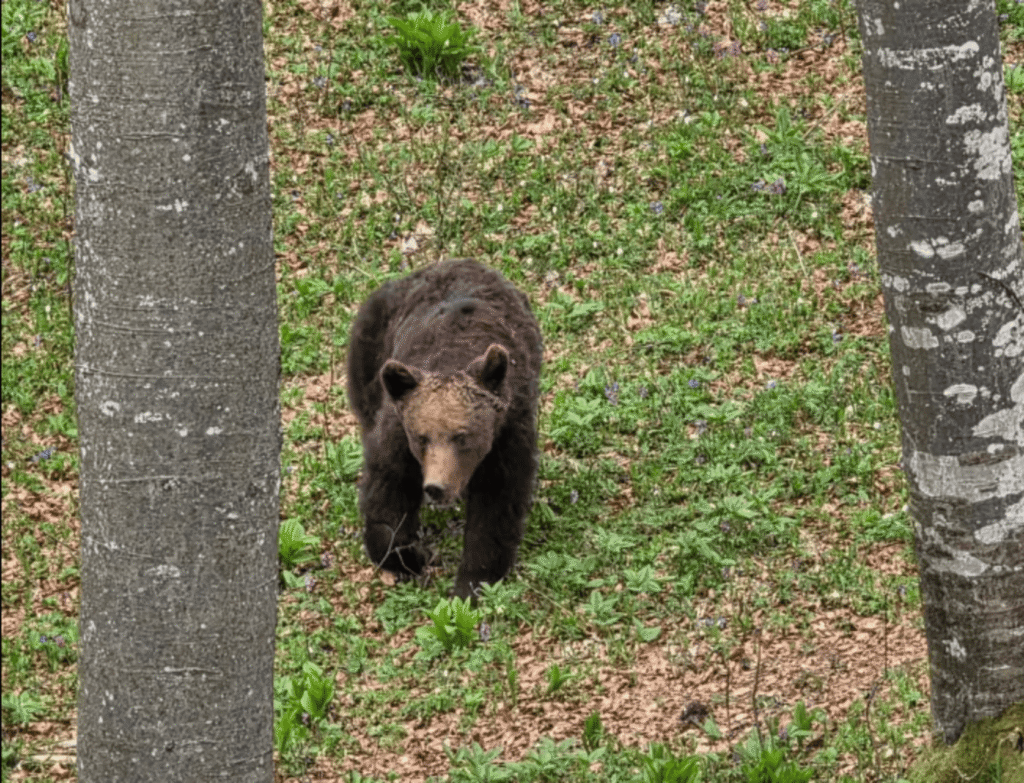
I know I’m not supposed to make a sound, so I’m making wild, enthusiastic pointing gestures. This is both exciting and a real treat! The bear has very dark brown fur. His large head is slightly lighter in color. He’s smaller than I expected. About 75 meters below us, he’s sniffing around among the trees. I notice that he (Grega will tell us on the way back that this was a male) is quite skittish. He looks around a lot, and every now and then he even jumps up and runs a short distance away from the clearing, seeking cover among the trees.
I grab my binoculars and see his dark fur, his nose, and his tiny, piercing eyes in crystal-clear detail. I don’t know if I’m imagining it, but it seems as though those little eyes are sometimes looking right at me (even though we’re sitting in the dark behind small windows).
Males weigh on average between 200 and even 300 kilograms (depending on the season), while females weigh about 100–150 kilograms. Then suddenly a second, slightly smaller bear appears among the trees. They both stand still and watch each other from a distance. It looks like a sort of “stare-down.” The newcomer stays a little ways off. We learn later that this is a female, and it’s also mating season.
But it soon becomes clear that eating is more important than mating right now. Slowly, she moves a little closer. The animals keep a close eye on each other. Back in the van, our guide will explain that it’s extremely rare for two bears to come to this spot. So this is truly a treat! He thinks it has to do with the changing weather. A storm and thunderstorm are on the way, and he says the animals can sense it. They’re eating their fill, and before the storm hits, they’ll take shelter in a dry spot in the forest.
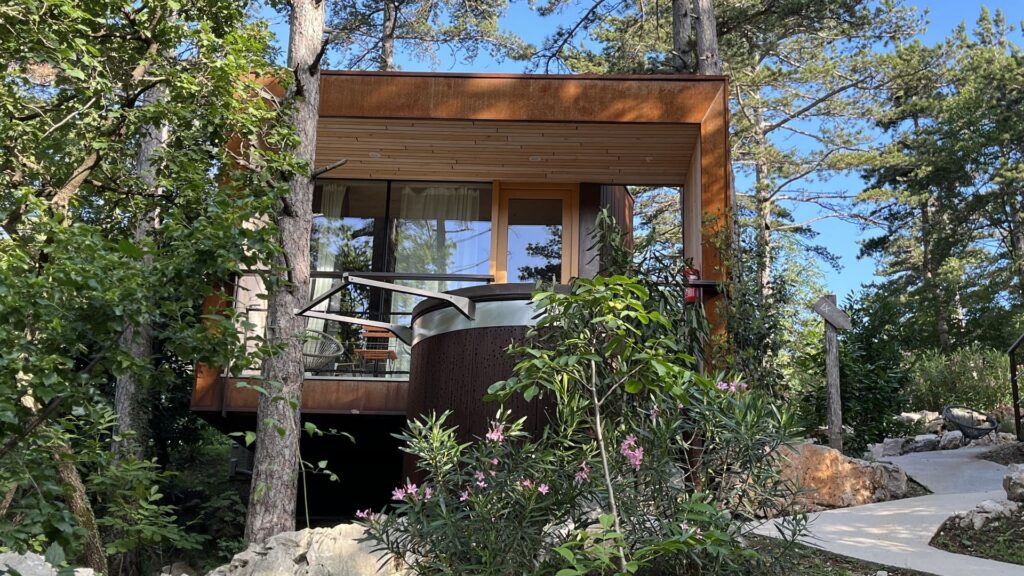
After the guide drops our little group off at the meeting point in Postojna, I drive half an hour to the Vipava Valley, famous for its Slovenian wines. Tonight, much like the bears, I’ll be sleeping among the trees in a unique forest cabin. Theodosius Forest Village has eight tastefully decorated cabins, each with its own hot tub, where I can relax after this amazing experience. I still can hardly believe that I saw bears in the wild for the first time!
The next morning, I’m woken up by a strange, hoarse roar or bark that comes and goes. “That’s not what a bear sounds like, is it?” I say out loud to myself. It’s not a bird either, because my bird app doesn’t respond when I turn it on. At breakfast, I learn it’s a roe deer. In the woods around the cabins, there are female roe deer with their fawns. Isn’t it wonderful to stay right in the middle of Slovenian nature and lose yourself in it completely?
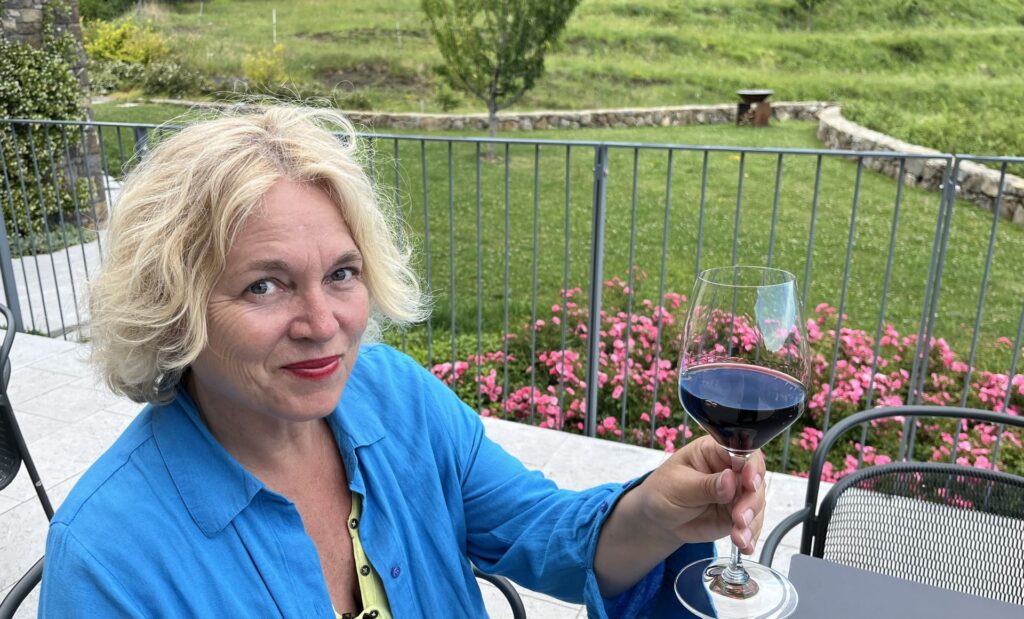
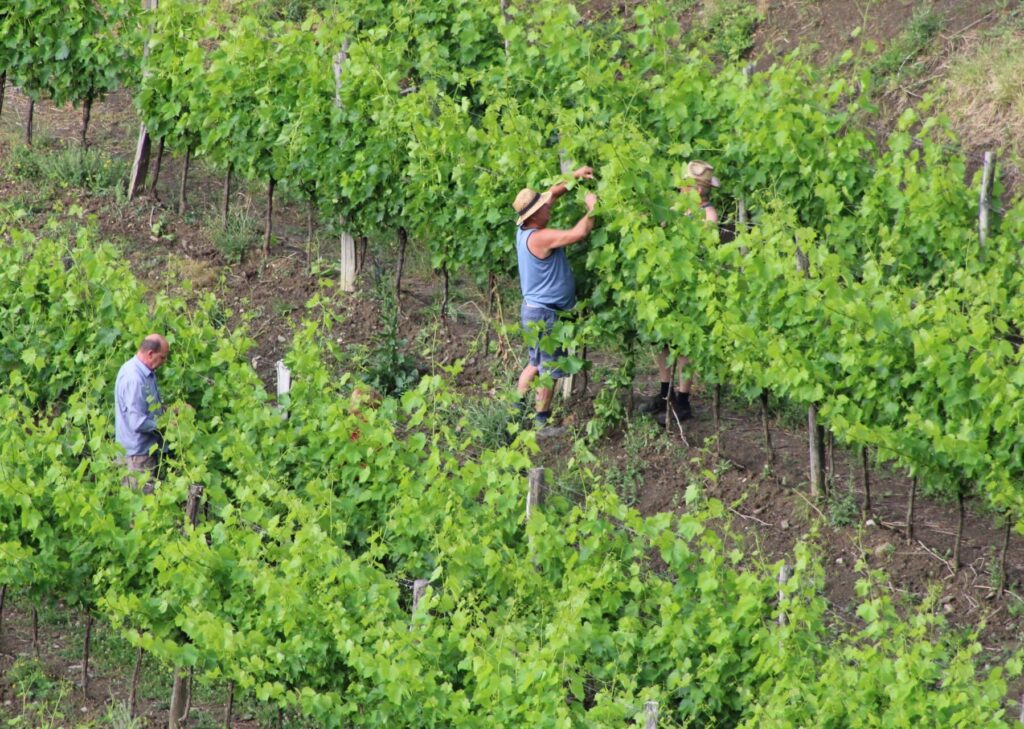
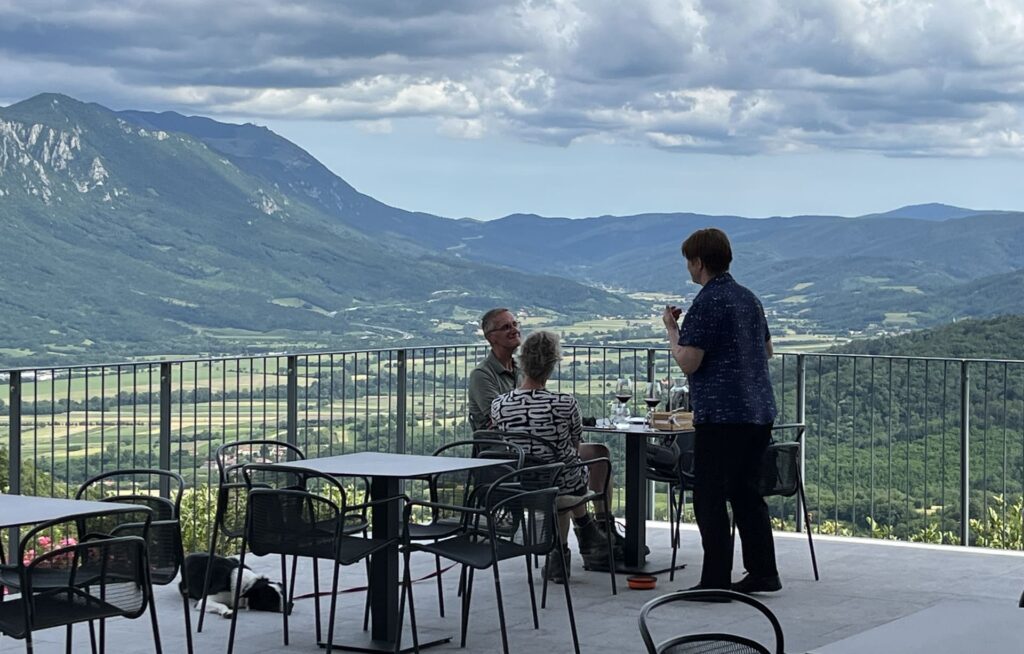
But “duty” calls. A wine tasting is on the agenda later today. I’m going to the Guerila winery, further down the Vipava Valley, to taste their biodynamic wine, and I’ll also be staying overnight in one of Guerila’s three apartments, which are aptly named after the grape varieties grown here, such as Pinela. Guerila is the brainchild of Zmagoslav Petrič. From childhood, Zmagoslav was taught to respect nature. And you can taste that in his organic white and red wines.
Slovenia has guidelines for the protection and management of bears. Tourism is part of that. The government designates locations where tour operators can take tourists to observe bears in their natural habitat from a hide.
In Slovenia, it is common practice in the context of tourism to set up feeding stations (usually stocked with corn) at carefully selected locations deep in the forests, where bears and other animals can feed. This is permitted only with official authorization from the Ministry of Natural Resources. The goal is also to prevent bears from entering areas where people live (which, in Slovenia—with a population of less than three million—is a somewhat smaller problem than in other countries).
Some animal welfare organizations are concerned that bears will become too accustomed to being fed. Forest Adventures’ tours are led by professional guides (who are also hunters), and every effort is made not to disturb the animals. Protecting the brown bear’s habitat is a top priority.
1. Notranjska Regional Park (near Postojna)
2. The Lož Valley and the Snežnik Forests
3. Kočevsko Region
The season runs from May through October.
The tours usually start about two hours before sunset, when bears are most active. There’s also a chance to see other animals, such as wild boars. There’s a good chance you’ll see bears, but there’s no 100% guarantee because they are still wild animals.
You’ll sit with the guide in specially designed, safe observation huts in the forest. Never go looking for wild animals, such as bears, without a guide.
I booked an excursion with Forest Adventures, an initiative by Matej Kavčič.
Nathalie
Bonjour, my name is Nathalie. France is my great passion. I take just about every opportunity to travel to France (preferably by train) to highlight undiscovered gems.
Whether cycling, hiking or climbing. I prefer to combine nature and culture so France is the place to be!
In addition to writing and vlogging, I organize (group) trips in cooperation with magazines and travel agencies.
For Nature Travel Lab, I also like to take occasional trips into my own country, the United Kingdom and whatever else comes my way. Will you join me?
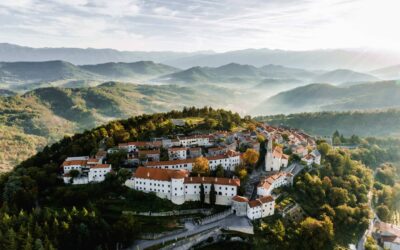
Karst & Vipava Valley: Discover the Unknown Side of Slovenia Geologists around the world use the term“karst”to describe a landscape of limestone, caves, and disappearing rivers. The name literally comes from this region: the Kras, in the far southwest of Slovenia,...

Aachen Off Track: A Green City Trip Featuring a Forest, an Organic Garden, and Charlemagne A city with an imperial history, surrounded by forests stretching all the way to the Belgian and Dutch borders. Aachen cannot be taken in at a single glance: its historic...
Get inspired
Are you looking for the most beautiful hiking and biking routes? Or do you want information about traveling by train or advice for the most beautiful road trips through nature. Get inspired for your next trip in green; ideas for planning your own trip or opting for an organized trip.